
Why Charcoal BBQs Are a Different Beast to Clean
If you’ve ever had a gas BBQ cleaned, forget everything you know about what that involves. Charcoal cooking creates a completely different type of mess — and a much more complex one.
With a gas unit, you’re mostly dealing with grease and food residue. With charcoal, you’ve got three things combining and hardening together every single time you cook:
• Ash residue — fine particles that settle into every crevice, absorb moisture, and turn into a paste-like compound when mixed with fat drippings
• Carbon deposits — thick, baked-on layers that build up on the bowl interior, lid, and cooking grate over time
• Grease layers — rendered fat from every cook that soaks down through the ash and settles at the bottom of the bowl
These three don’t sit separately. They bond together. After enough cooks, you’re dealing with a hardened, compacted layer of ash-grease-carbon that no standard brush or household spray is going to shift properly.
And in Newcastle, the coastal humidity speeds this process up significantly. Moisture gets into the bowl between cooks — especially in suburbs close to the water — and causes that ash and grease mixture to harden faster and start attacking the bowl’s surface underneath.
A basic ash empty-out doesn’t touch any of this. That’s the difference between maintaining your BBQ and actually cleaning it.

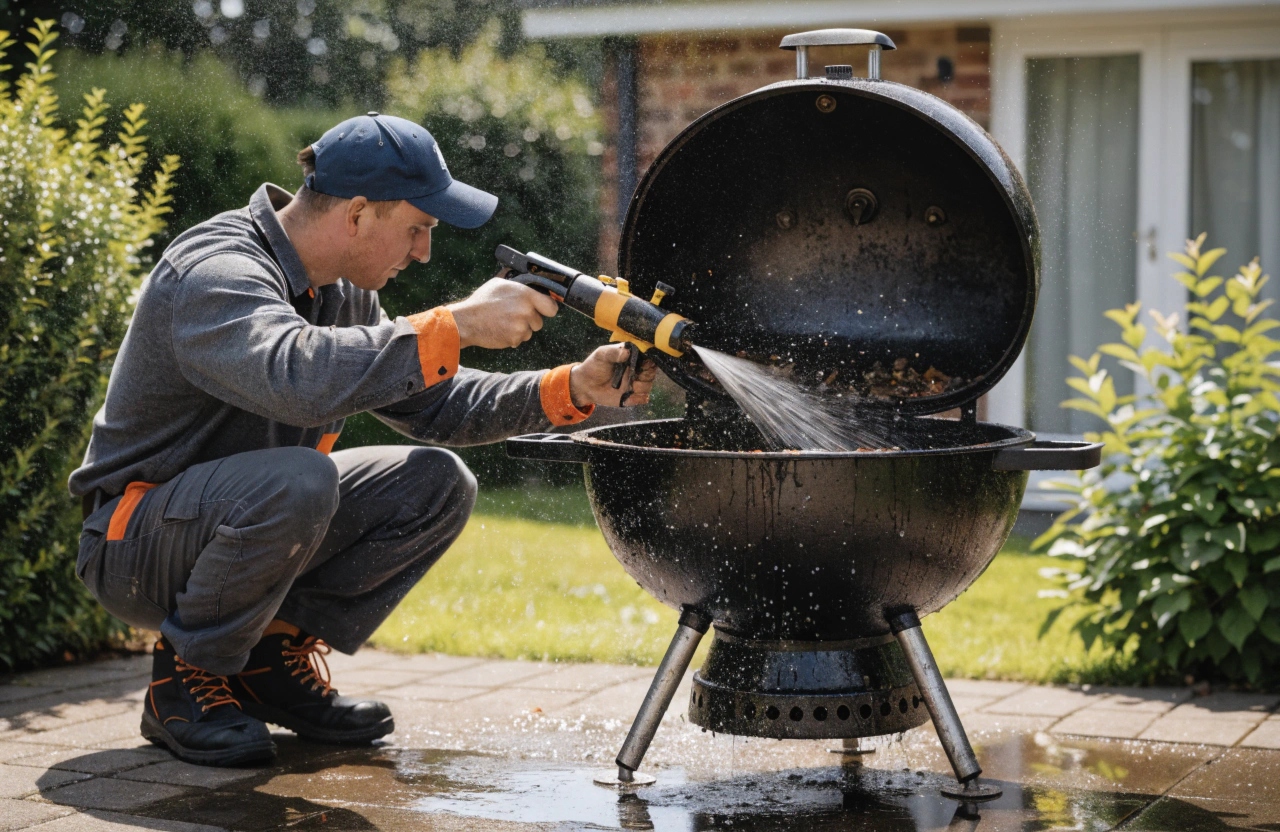
What a Professional Charcoal BBQ Clean Actually Covers
Most charcoal BBQ owners are surprised when they see the full list of components that need attention during a proper professional clean. It’s not just the grates — it’s the whole unit.
The Key Components We Clean
Ash Catcher & Bottom Bowl
The ash catcher cops the most neglect. Old ash mixed with grease and sitting in there through multiple cooks becomes a hygiene problem, not just a visual one. We clear it completely and clean the bowl interior down to bare metal where possible.
Charcoal Grate
The grate that holds your coals gets coated with carbon and grease from below every single cook. A blocked or clogged charcoal grate directly affects how your coals breathe and how evenly your heat distributes.
Cooking Grate
Baked-on carbon and old food residue on the cooking grate affects flavour and creates cross-contamination between cooks. We remove buildup properly — not just a brush-off.
Lid Interior
This one’s often the most visually dramatic. The inside of the lid collects thick carbon deposits from smoke and heat cycling. Left long enough, those deposits flake and drop onto your food.
Vents and Dampers
Blocked vents are one of the most overlooked performance issues in charcoal cooking. If your top or bottom vents are clogged with ash and grease residue, you’ve lost control of your temperature — full stop. We clear and check every vent as part of every clean.
The Hygiene Problem Hiding Inside Your Charcoal BBQ
Here’s something most charcoal BBQ owners don’t think about until someone points it out. Every time you cook and leave old ash sitting in the bowl, you’re not just leaving a mess — you’re creating the right conditions for something genuinely unpleasant.
Old ash is porous. It absorbs everything around it — grease drippings, moisture from the air, whatever residue comes down from the cooking grate. In Newcastle’s humid coastal climate, that moisture doesn’t have far to travel. Suburbs like Mayfield and The Hill sit close enough to the water that even a covered BBQ will pull in humidity between cooks.
What you end up with is a damp, greasy ash bed sitting at the bottom of your bowl. Left across multiple cooks, that mixture becomes a breeding ground for bacteria and mould — sitting directly beneath the food you’re cooking.
The Lid Interior Is Just as Important
The inside of your lid tells a different story but carries the same risk. Every smoke session coats that surface with carbon deposits from the combustion cycle. Over time, those deposits thicken, dry out, and start to flake.
Those flakes fall onto your food.
Beyond the contamination issue, heavy carbon buildup on the lid interior actually changes how smoke circulates inside the cook chamber. The result is a harsher, more acrid smoke flavour instead of the clean, rounded smoke your charcoal is supposed to deliver.
If your food has started tasting slightly bitter or sharp, the lid interior is the first place worth looking.
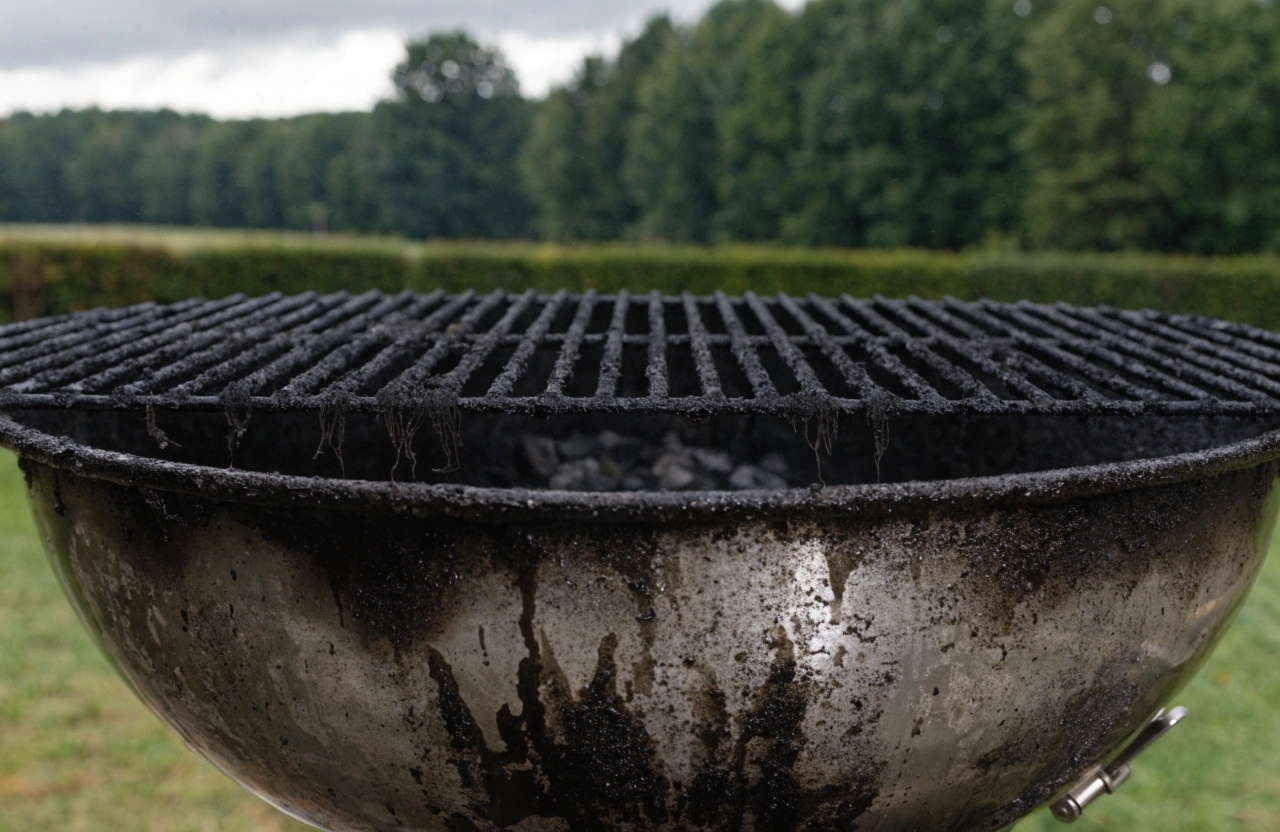
Blocked Vents and Why Your Temperature Control Has Suffered
If you’ve noticed your charcoal BBQ running hotter than it should, struggling to hold a steady low temperature, or taking longer than usual to get up to heat — the vents are almost always part of the problem.
Charcoal cooking is temperature management. That’s the whole game. And your vents — both the bottom intake vent and the top exhaust damper — are how you control the oxygen supply to your coals. More airflow, more heat. Restricted airflow, lower and slower.
When ash and grease residue builds up inside and around those vents, you lose that control. The vent might look open from the outside but be partially blocked with compacted residue you can’t see without getting right in there.
What Clogged Vents Actually Do to Your Cook
• Your coals struggle to establish properly, burning unevenly from the start
• Low-and-slow cooks drift above target temperature because the exhaust vent can’t regulate properly
• Hot and fast cooks won’t climb high enough because the intake can’t pull sufficient oxygen
• Temperature swings become unpredictable, making it nearly impossible to time your cook accurately
Most charcoal BBQ owners assume temperature inconsistency is a charcoal quality issue or a technique issue. Sometimes it is. But if your vents haven’t been properly cleared in over a year of regular cooking, the equipment itself is working against you before the first coal is lit.
Clearing and checking every vent is a non-negotiable part of every professional clean we carry out.
What Newcastle's Coastal Climate Does to a Neglected Charcoal BBQ
Newcastle is a brilliant place to own a charcoal BBQ. The climate is mild enough to cook year-round, the backyard entertaining culture is deeply ingrained, and there’s no shortage of weekends worth firing up for. But that same coastal environment creates a specific maintenance challenge that inland BBQ owners simply don’t deal with at the same level.
Salt air and humidity are relentless on exposed metal. And the inside of a charcoal BBQ bowl — sitting with residual ash, grease, and moisture after every cook — is about as vulnerable as it gets.
What’s Actually Happening Inside the Bowl
When ash absorbs moisture from Newcastle’s coastal air, it becomes mildly acidic. That acidic, damp ash compound sits against the interior surface of your bowl between cooks — and over time, it eats into the enamel or steel beneath it.
Suburbs like Cooks Hill, Bar Beach, and Merewether are close enough to the water that this process is noticeably faster than what owners in Beresfield or Maitland experience. But no part of the Newcastle area is dry enough to be immune to it.
The damage starts silently. You won’t see it happening. But after a season or two of neglected ash sitting in a humid bowl, the interior surface starts to pit and corrode — and once that protective layer is compromised, the deterioration accelerates quickly.
A professional clean removes the ash and grease compound before it has the chance to do that damage. It’s not just about performance — in Newcastle’s climate, it’s genuinely about protecting the lifespan of the equipment you invested in.
How Often Should Your Charcoal BBQ Be Professionally Cleaned?
The honest answer is — it depends on how often you’re cooking. But there are some straightforward guidelines that make it easy to work out where you sit.
A Simple Guide Based on Cooking Frequency
| Cooking Frequency | Recommended Cleans Per Year | Notes |
| Occasional — 1 to 2 cooks per month | Once per year | End of heavy cooking season — late autumn in Newcastle — is the smart time to book |
| Regular — 3 to 4 cooks per month | Twice per year | Once heading into warmer months, once at the close. Newcastle’s mild climate means buildup accumulates year-round |
| Heavy use — weekly or more | Three to four times per year | Ash and grease compound builds quickly. Vent blockage becomes a real performance issue within months |
The Rule of Thumb Worth Remembering
If you’ve done more than fifteen cooks since the last professional clean, it’s time. Not because something is necessarily broken — but because the buildup you can’t see is already affecting the cooks you think are going perfectly.
A basic ash empty after each cook is good habit. But that’s maintenance, not cleaning. The two aren’t the same thing, and treating them as the same is how a quality charcoal BBQ ages five years in two.
Frequently Asked Questions About Charcoal BBQ Cleaning in Newcastle
Most standard kettle BBQs take between 60 and 90 minutes on-site. Larger kamado-style units or heavily neglected BBQs with significant carbon buildup may take longer. We’ll give you an honest time estimate when you book.
Just make sure the BBQ is cool and hasn’t been used in the 24 hours before the appointment. You don’t need to empty the ash or pre-clean anything — that’s exactly what we’re there for.
No. We use cleaning methods and products that are appropriate for the specific surfaces inside a charcoal BBQ. Aggressive chemicals that damage enamel coatings are not part of how we work.
More often than not, a BBQ that looks past its best on the outside is still structurally sound inside. A professional clean removes the buildup and lets you accurately assess the real condition of the bowl, grates, and vents. We’ll give you an honest read on what we find — if replacement makes more sense than continued maintenance, we’ll tell you.
Yes. We cover the full Newcastle area including Cooks Hill, Mayfield, The Hill, Hamilton, Charlestown, Wallsend, Beresfield, and all surrounding suburbs. If you’re not sure whether we reach your area, just ask when you get in touch.